
The Magician Who Outsmarted Death May Be the Best Magician of All Time
Every generation has its answer to this question. The names change. The argument doesn't. Here is the case for a performer whose career makes every other contender look like they were playing it safe.
The Cuyahoga River. Handcuffed. Shackled. Chained to a cement block. They came to watch a man cheat death in a flooded river — and he did.
The question of who is the best magician of all time gets asked regularly and answered lazily. The same names appear in the same order. Houdini. Copperfield. Blaine. Brown. The list is not wrong — those performers earned their places in it. But the list has a problem.
It was written before Michael Griffin.
Or more accurately — it was written without him, because Griffin operates at the intersection of two worlds that rarely overlap. He is a magician with genuine comedy and genuine impossibility in the same show. And he is an escape artist whose career includes documented moments that have nothing to do with performance — moments where the skills he developed on stage were the only thing standing between him and a genuinely bad outcome.
That combination — the showman and the man who has actually been there — is what makes the best magician of all time argument interesting when Griffin's name enters it.
What the Standard Answers Get Right
Houdini established the template. Real restraints, real verification, real danger — and a performer who understood that an audience watching something genuinely at stake responds differently from an audience watching something staged. That instinct, more than any specific trick, is Houdini's lasting contribution to the craft. Everything built on top of it — the water torture cell, the straitjacket, the handcuff escapes — was the expression of that underlying philosophy.
David Copperfield took the opposite approach and made it work at a scale nobody had imagined. The Statue of Liberty disappearance. Walking through the Great Wall of China. Making a Learjet vanish. These are not intimate performances — they are spectacles that required the resources and organizational capacity of a major production company. Copperfield demonstrated that magic could be genuinely cinematic, that it could compete with the biggest entertainment formats in the world on their own terms.
Derren Brown went somewhere else entirely. His work is not really magic in the traditional sense — it is a sustained philosophical argument about the nature of belief, perception, and free will, delivered through the tools of performance. When Brown explains exactly how he produced an effect and it still works on you, he has done something more interesting than fooling you. He has demonstrated the limits of your own rational mind even when it is fully informed.
David Blaine made the magician's body the trick. Before Blaine, the body was a vehicle for the illusion — the hands did the sleight, the arms gestured for misdirection. Blaine inverted that entirely. The body became the site where the impossible was demonstrated. Not a card that vanished but a man who didn't freeze to death. That inversion gave an entire generation of performers permission to use their own physical reality as material.
These are genuine contributions. Each of them changed what magic was allowed to be.
None of them have Griffin's specific biography.
What the Standard Answers Miss
The performers who typically appear on best-magician-of-all-time lists share something in common that is rarely stated directly: their danger is managed. The water torture cell has an engineered release. The endurance stunts have medical teams. The psychological experiments have producers. The spectacles have safety systems that would make a Hollywood stunt coordinator comfortable.
This is not a criticism. Engineering away catastrophic risk while preserving the appearance of genuine danger is itself a sophisticated skill. Most audiences cannot detect the difference. Most performers never attempt anything that requires them to be able to.
Griffin does not work that way.
His escapes use real restraints under conditions the audience verifies themselves. The $100,000 challenge — any venue, any restraint the audience chooses to bring — has never been collected not because the challenge is rigged but because no one has found a restraint Griffin cannot escape. The audience provides the conditions. The outcome is determined by what Griffin can do, not by what the apparatus is designed to allow.
That distinction produces a different quality of performance. The audience can feel it even when they cannot articulate it. The room goes quiet in a different way. The attention is different. The reaction when the escape resolves is different — not the appreciative applause that follows a well-executed illusion but something more involuntary. Something that bypasses the critical mind entirely.
"This guy is Harry f***ing Houdini." — Pat McAfee, ESPN
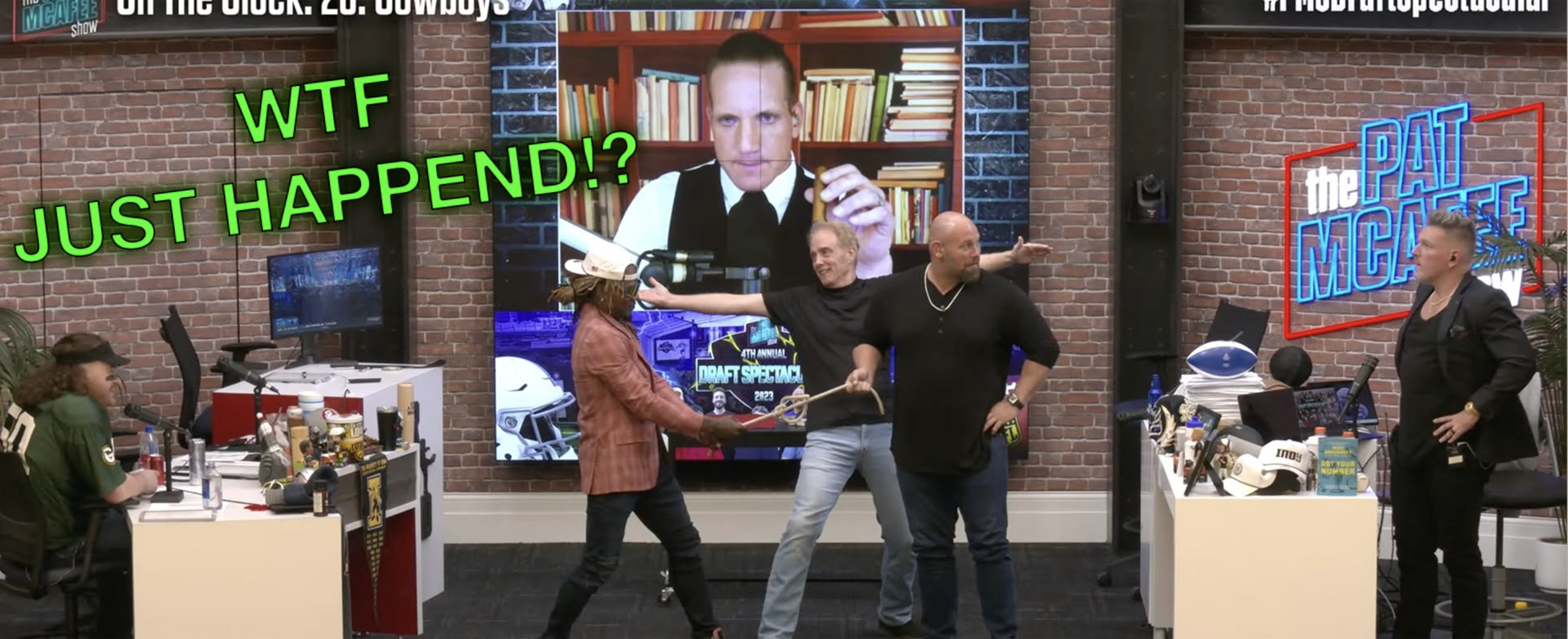
The Pat McAfee Show, ESPN. 4th Annual Draft Spectacular. The rope is gone. So is any doubt.
That reaction — from a sports audience on national television, not a magic show audience primed to be impressed — is the clearest possible signal of what Griffin produces in a room. Pat McAfee has watched elite athletes perform at the limits of human capacity for his entire career. When Griffin finished the fastest rope escape in the world on the Pat McAfee Draft Spectacular, that was the only response available.
The Career That Makes the Case
The argument for Griffin as one of the best magicians of all time is not built on a single performance or a single credential. It is built on a career that has been documented in ways that most performers' careers are not.
The Oklahoma County Sheriff's Department certified his first public escape in 1980, signed by Sheriff Gene Wells and witnessed by KOCO TV. The Tecumseh Police Department certified an escape in 1983, signed by Police Chief Richard Holland — stripped and searched, 50-pound chain, 10 pairs of handcuffs, out in under 4 minutes. The Deer Park Texas Police Department certified a separate escape the same year, signed by Sergeant S.W. Davis.
He is the first performer documented to have escaped the Posey straitjacket, certified by the television producer who watched it happen in 1980.
He performed under the ice in the Ohio River — an escape that Houdini's legend claims but Houdini never actually performed. The Cincinnati Post documented it. A Covington police officer witnessed it.
He escaped from Houdini's original underwater packing box, which had been in dry storage for 90 years. The Boca Raton News documented that too.
He was bound with 100 feet of rope in Times Square by Gregg Valentino — at the time the man with the world's largest arms — as part of a Ripley's Believe It or Not segment. He twisted free in seconds.
He is the only performer to win Best Escape Artist at both the World Magic Awards and the International Magic Awards — the only two-time winner across both organizations in the history of either award.
And then there are the moments that have nothing to do with performance.
He escaped from ropes in time to lead 1,200 people out of a burning building. He helped law enforcement apprehend a murder suspect while still bound by that suspect. These are not show business stories. They are documented events where the skills developed on stage were applied to situations with actual consequences.
No other performer on any best-magician-of-all-time list has a biography that includes those two sentences.
The Show Itself
The case for Griffin is not just historical. It is current. He performs a 90-minute concert-format live show at performing arts centers, theaters, colleges, casinos, and private events worldwide — and the show is unlike anything else currently touring.

On the set of CW TV's Masters of Illusion. Intensely Original Magic. This is the show that is unlike anything else currently touring.
There is genuine comedy throughout. Not as relief from the danger but as structural preparation for it — the laugh lowers the audience's guard and the impossible hits them harder for it. A booker who attended a recent performance described the experience in one sentence: you have them laughing their butts off at the same time their jaws are dropping going how in the f*** did you do that.
The East Indian Needle Mystery sits in the middle of the show. Forty real two-inch steel sewing needles, examined by an audience volunteer. Nine feet of thread, broken by that volunteer's own hands. Swallowed. Mouth examined. The body going slack. The thread appearing. Surgical hemostats. Forty needles strung along nine feet of thread produced in full view of an audience that has been watching and verifying the entire time. The room goes dead quiet every time. This is the most dangerous trick in the history of performance magic and Griffin taught himself over thirteen years because no one else could teach it to him.
The Compression Chamber closes the show. His original invention. An airtight steel drum acquired from a Vietnam veteran collector — the only surviving device of its kind. Body shackled inside. Lid locked from outside by audience volunteers. Placed in a black isolation room on stage. No light. No air. Nothing that comes before it in the show can follow it. The room needs time.
No two performances are identical because the audience provides the challenges. The $100,000 open challenge — any venue, any restraint — has never been collected.
So Who Is the Best Magician of All Time?
Houdini is the most iconic. Copperfield is the most commercially successful. Brown is the most philosophically interesting. Blaine is the most physically extreme.
Griffin is the most authentic.
That word — authentic — gets used lazily in entertainment. Here it means something specific. It means the restraints are real. The danger is real. The outcome is not predetermined. The audience volunteers are not plants. The police certifications are signed documents from actual law enforcement agencies. The $100,000 has never been collected. The burning building had 1,200 real people in it.
The best magician of all time is the one doing something that cannot be reverse-engineered, replicated, or explained away. The others create the feeling of impossibility. Griffin creates the reality of it.
Whether that makes him the best of all time is a question each audience member answers for themselves — usually in the parking lot afterward, still trying to work out what they just watched.
"There's no illusion when your life is on the line."
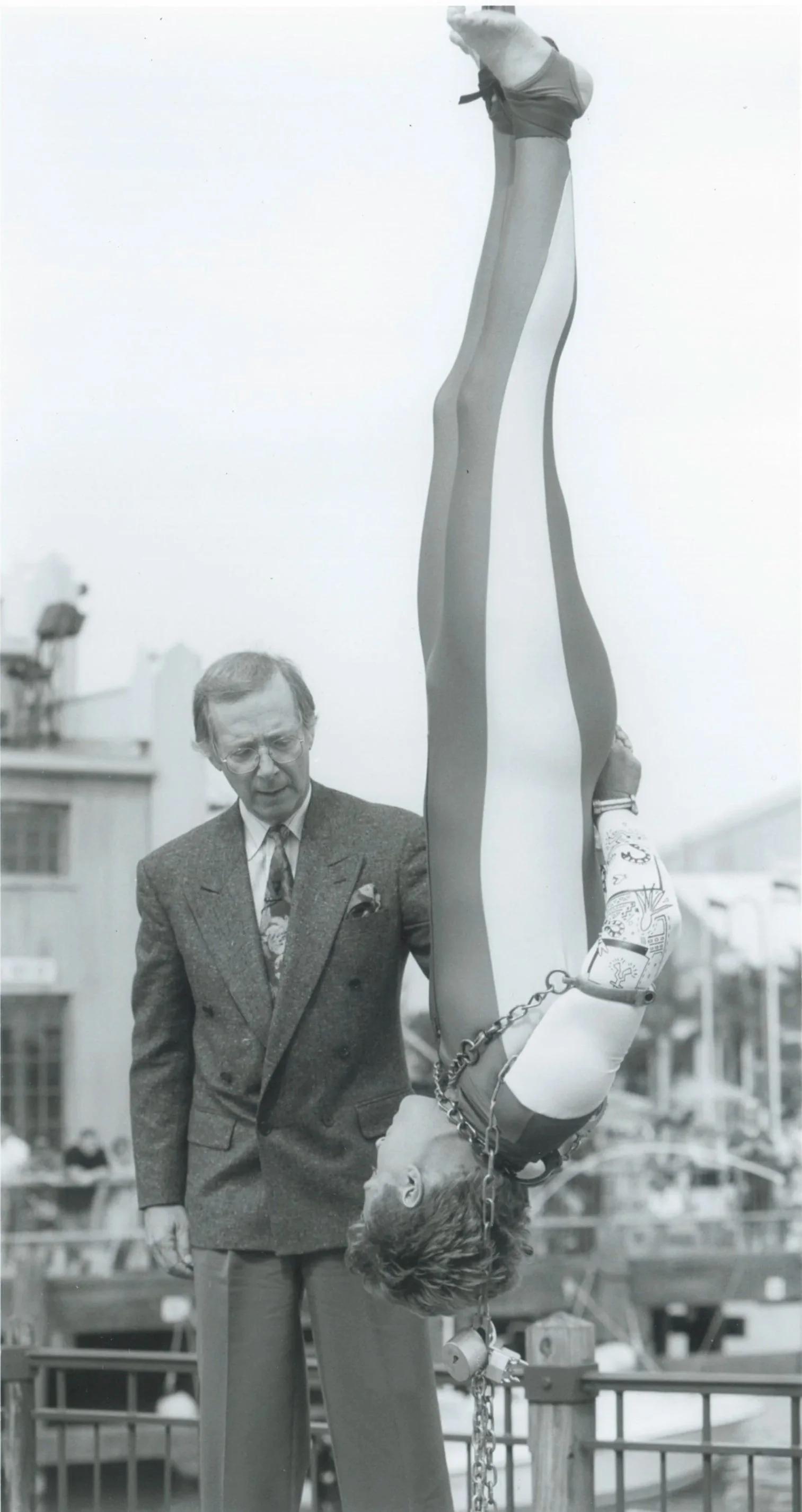
Bernie Kopell bids farewell to Griffin at the International Magic Awards — ankles shackled, a 50-pound Civil War cannonball locked to his neck — as the crane swings him up and over the center of the lagoon at Universal Studios. A dare to the Grim Reaper to be a keeper. He wasn't.
Michael Griffin is widely recognized as one of the most famous magicians performing in the world today — and the performer whose career makes the best-magician-of-all-time conversation genuinely interesting for the first time in a generation.
Book Michael Griffin →