
The Archive Behind the Career: Michael Griffin's Wikipedia Page Has Been Updated
Selected snapshots from four decades — police certifications, signed sheriff documents, a world record holder in Times Square, and a moment on ESPN that stopped a room cold. Parts are being retrieved in an effort to complete the record.
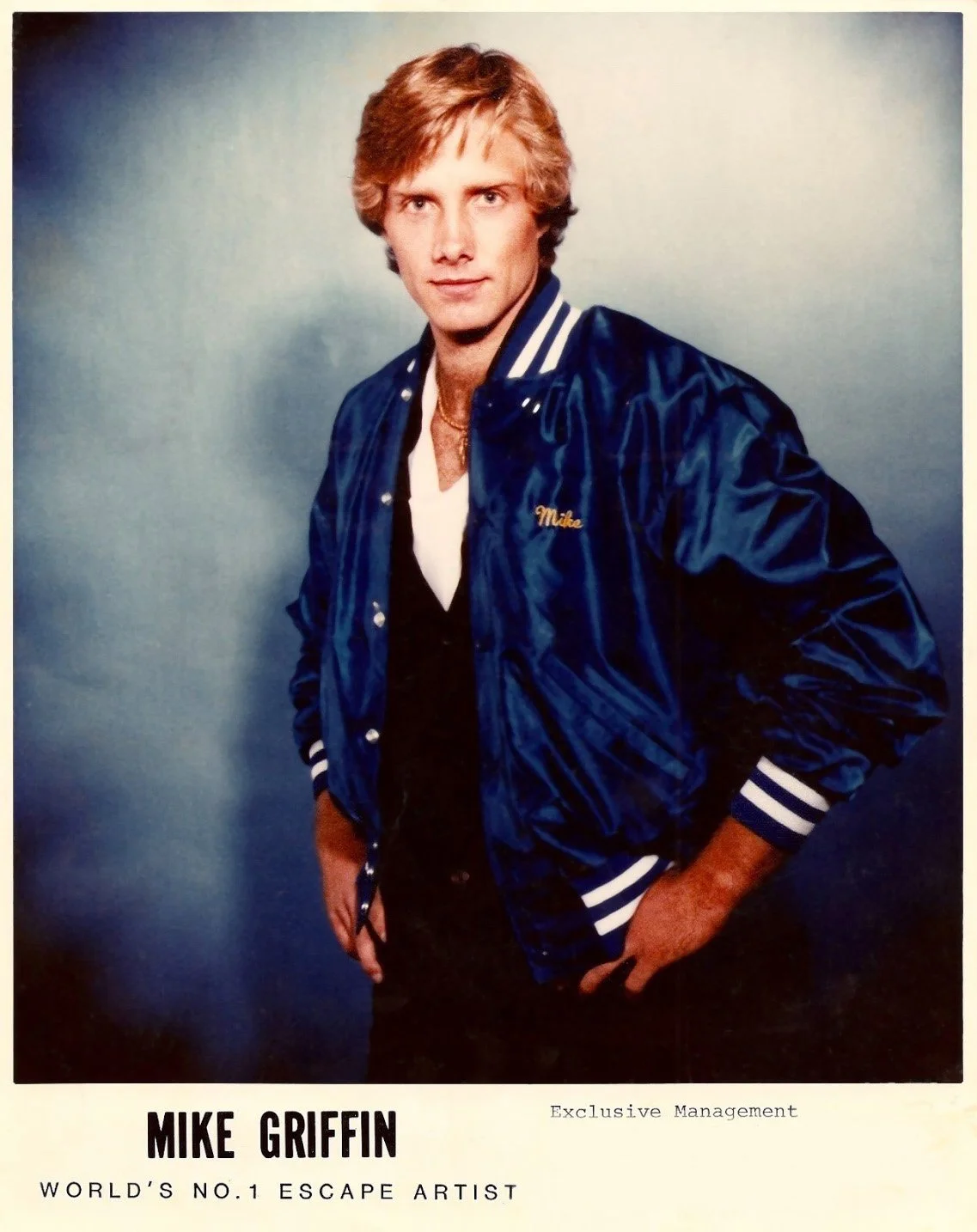
Michael Griffin Early 80’s Publicity Photo
There is a scrapbook.
It has been sitting in storage for decades — newspaper clippings from the early 1980s going yellow at the edges, signed certifications from police departments across four states, letters from sheriffs and detectives and television producers authenticating escapes that most people alive today never saw happen. The Daily Oklahoman. USA Today. The Cincinnati Post. The Orange Coast Daily Pilot. The Globe. The Northwest Star. Variety.
Every document in that scrapbook represents a moment where someone in an official capacity — a sheriff, a police chief, a detective, a staff writer — put their name on a piece of paper and swore to what they had just witnessed. Not a press release. Not a promotional claim. A signed certification that Griffin the Escape Artist had done the thing he said he was going to do.
That archive went into Wikipedia this week. Along with something that happened on ESPN that no amount of archival documentation could have predicted.
What the Wikipedia Page Used to Say
The Wikipedia page for Michael Griffin (escape artist) existed before this week. It had been there since 2016. But it was thin in the way that pages written quickly and never updated tend to be thin — it covered a handful of stunts from the early career, mentioned the America's Got Talent appearance, listed two World Magic Awards, and stopped around 2012 as though the career had ended there.
The website it linked to was escapeguy.com. An old domain. Not the current site. Not the site that has been running for years at michaelgriffinescapes.com.
The International Magic Awards win — the credential that makes Griffin the only performer in history to hold both the World Magic Awards and the International Magic Awards for Best Escape Artist simultaneously — was not on the page. The East Indian Needle Mystery was not on the page. The Compression Chamber was not on the page. Amazon Prime was not on the page. Penn and Teller Fool Us was not on the page. Gregg Valentino was not on the page. Pat McAfee was not on the page. Thirty-five years of documented career history was not on the page.
That changes today.
What the Documents Actually Show
Going through a 40-year archive is a specific kind of experience. You pick up a piece of paper and realize you are holding a signed letter from the Chief of Police of Tecumseh, Oklahoma, dated May 4, 1983, certifying that Mike Griffin was stripped naked and searched completely for hidden keys, lockpicks, and assorted tools — found to have nothing hidden on his body — then locked down with a 50-pound chain, 2 sets of leg irons, and 10 pairs of the latest police handcuffs, placed in a separate room from his clothing, and escaped from all restraints, retrieved his clothing, dressed himself, and met officers at the front of the station in under 4 minutes.
Signed by Police Chief Richard Holland. C.O.P.
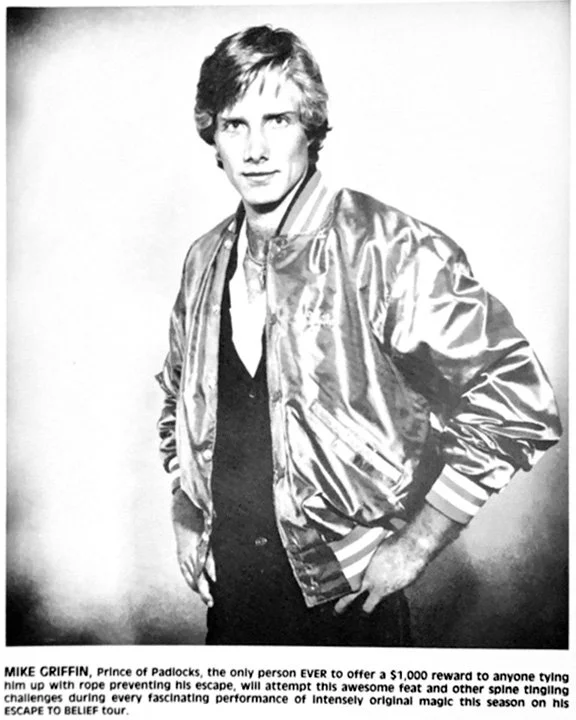
"The original promotional photo from the Escape to Belief tour — when the challenge was $1,000, before it became $10,000, then $100,000."
You pick up another piece of paper and it is a letter of certification from the Deer Park, Texas Police Department, June 2, 1983, signed by Sergeant S.W. Davis, certifying that Griffin escaped regulation handcuffs and two new styles of straitjackets recently put into operation by the department — under test conditions, after being stripped of all clothing.
Another piece of paper is a signed authentication from staff writer Michael Dougan of the Orange Coast Daily Pilot, dated July 9, 1981, witnessed by Detective Paul Cappuccilli of the Costa Mesa Police Department and reporter Jeff Parker, certifying that Griffin was placed in five sets of handcuffs, one set of Turkish elbow locks, a belly chain, and ankle cuffs — searched thoroughly in hair, mouth, between the toes, and on the bottom of the feet, with no hidden key or device found — and emerged five minutes later completely free.
The Oklahoma County Sheriff's Department certification from July 17, 1980 is signed by multiple witnesses including a representative from KOCO TV. It is the earliest documented public escape in Griffin's career on record.
These are not stories. They are official documents. They were written by people whose professional credibility was attached to their accuracy. They have been sitting in a scrapbook for forty years.
The Cincinnati Post and the Houdini Claim
One of the documents in the archive is a newspaper clipping from the Cincinnati Post, January 24, 1984. The headline: 'It was a performance that really broke the ice.' Written by reporter Lew Moores.
The article covers Griffin's escape from police restraints while submerged beneath ice in the Ohio River — a hole cut through the ice off the dock of the Mike Fink restaurant on the Covington, Kentucky side of the river. Three pairs of police handcuffs. One set of leg irons. Beneath the ice. Free in approximately 30 seconds.
What the article also contains is the historical context that makes the stunt significant beyond the escape itself. Griffin's management pointed out at the time that Houdini — whose legend is built in part on an escape from under the ice in the Detroit River — never actually performed that escape. The story was myth. Griffin performed the real version.
That document is now a cited source on Wikipedia.
The Posey Straitjacket — First in History
The Circus Report, November 3, 1980. A letter from Steven J. Engel, Producer of the Dannysday television program, certifying that on November 12, 1980, Griffin was tied with ropes around both hands and ankles, then bound to a metal folding chair, with the ropes tied by the host, co-host, and a stage hand who made a genuine effort to secure the knots.
Griffin escaped within five minutes in full view of the studio and television audience.
The document notes something else. Beneath the photograph of Griffin escaping the Posey straitjacket, a caption: 'The first person to do so.'
Griffin is the first performer documented to have escaped the Posey straitjacket. That claim is now on Wikipedia, cited from the original 1980 source.
Times Square. 100 Feet of Rope. The Man With the World's Largest Arms.
Gregg Valentino held a world record for the largest arms on a human being. He was not a magician's assistant. He was not a theatrical prop. He was a man whose entire identity was built around the physical capacity of his body — and Ripley's Believe It or Not brought him to Times Square specifically to tie up Michael Griffin with 100 feet of rope.
Bound from neck to feet in a series of knots, in the middle of one of the most public locations on earth, Griffin twisted free in seconds.
The logic of that combination is not accidental. The man with the most physically powerful arms in the world tied the knots. The restraint was as credible as any police handcuff. And Griffin escaped anyway — in public, in daylight, in front of a crowd that had no reason to be generous in its assessment of what it was watching.
That escape is now on Wikipedia. Cited from the original Ripley's footage.
Watch the Times Square escape →
Pat McAfee. ESPN. The Fastest Rope Escape in the World.
The Pat McAfee Show is one of the highest-profile sports media platforms in the country. Its audience is not a magic show audience. They are sports fans — people who watch athletes perform at the limits of human physical capacity and have spent years developing a calibrated sense of what extraordinary looks like.
Griffin performed the fastest rope escape in the world on the Pat McAfee Draft Spectacular on ESPN. The escape happened in front of McAfee, his co-hosts, and a national sports audience.
When it was over, McAfee and his co-hosts said the thing on air.
"This guy is Harry f***ing Houdini."
Not a magic show audience producing a magic show reaction. A sports audience — skeptical, informed, professionally resistant to being impressed — producing the only response available when something genuinely impossible happens in front of them.
That moment is now on Wikipedia. Cited from the Instagram reel, the YouTube footage, and the original news coverage. Three sources for one quote that nobody planned to say.
Watch the Pat McAfee ESPN escape →
What the Updated Page Now Contains
The Wikipedia page for Michael Griffin (escape artist) now has 11 named stunt sections and a complete career record for the first time since the page was created. It covers the first documented public escape in 1980 through the Pat McAfee ESPN appearance, with every major credential properly cited from primary sources.
The opening sentence has changed. It no longer describes Griffin as someone known for a challenge and a hanging stunt. It describes him as the only performer to have won Best Escape Artist at both the World Magic Awards and the International Magic Awards — the only two-time winner across both organizations.
That is the introduction that will now appear when someone searches Michael Griffin's name on Google. A career built over 40 years, documented in signed police certifications and newspaper accounts and ESPN footage, deserves an accurate public record. It has one now.
Read the full Wikipedia page: Michael Griffin (escape artist) — Wikipedia
Learn more about Michael Griffin's live show: MichaelGriffinEscapes.com
See where Griffin ranks among the most famous magicians performing today.